Each winter, Coeur d’Alene, ID serves as a crucial pitstop for hundreds of migrating bald eagles en route to their spring nesting grounds in Alaska. They’ll feast on the small sockeye salmon, called kokanee, that spawn by the thousands in Lake Coeur d’Alene’s Wolf Lodge Bay. Eagle watching is a great pastime during holiday visits to my mother-in-law, who’s lived in the Coeur d’Alene area for 25 years.
I was fortunate to spot well over 100 in January 2023 on the Coeur d’Alene Resort’s popular eagle cruise. (The boat stays far from the shore where the eagles roost, ensuring a safe distance.) I’ll never forget the awe of watching a bald eagle circle closer while we shivered at the bow. Suddenly, it shot up like a flare, then plunged into the waves below. Seconds later it emerged triumphant, a shadowy catch—no doubt salmon—in its talons. In the distance, dozens of white heads blotted the evergreens on the horizon. On a day with strong numbers and plenty of sunshine, bearing witness to this annual ritual felt like a small miracle.
Bald eagles have been on my mind this winter closer to home. There are several well-known spots to see bald eagles in the Hudson Valley, notably Croton Point Park, a thankfully restored former landfill, and Steamboat Riverfront Park.
Encouraged by the promising tallies on eBird, I took the train to Steamboat Riverfront Park on a frigid afternoon in February. Temperatures are only in the teens, and the wind, always fiercer along the water, seems especially strong. Accustomed to the soft buzz of highway traffic at Tibbetts Brook Park in Yonkers, NY, the quiet is jarring. I scanned the naked trees, hoping to catch an eagle roosting. No such luck. The wind howled; I wish I’d grabbed thicker gloves.
Flooded by memories of the glorious sightings at Lake Coeur d’Alene, I was reminded of my first whale watch, age six, when I wept uncontrollably because the whales didn’t breach like they did on the brochure cover. A few weeks earlier, I’d spotted two bald eagles flying overhead while volunteering at the Hudson River EagleFest®.
I ached to see more.
But now I felt like a bad birder, disappointed by not seeing eagles right away. More than a century after the second Industrial Revolution, I worry about our perception of nature being separate from us, a destination rather than a critical part of our world’s whole. Rather than enjoying the solitude of a winter day, I yearned to glimpse a bald eagle, rendering nature as spectacle.
A light snow started falling, forcing me back into the present. But the snow made it even harder to scan the icy floes atop the half-frozen Hudson. Still, maybe if I zoomed in, I could see something. Fingers raw and shaking, I peered through the lens.
Sure enough, crouched on ice hundreds of yards away, two mature bald eagles feasted on the remains of a fish. Nearby was a juvenile. (The white heads appear when a bald eagle is 4-5 years old.)
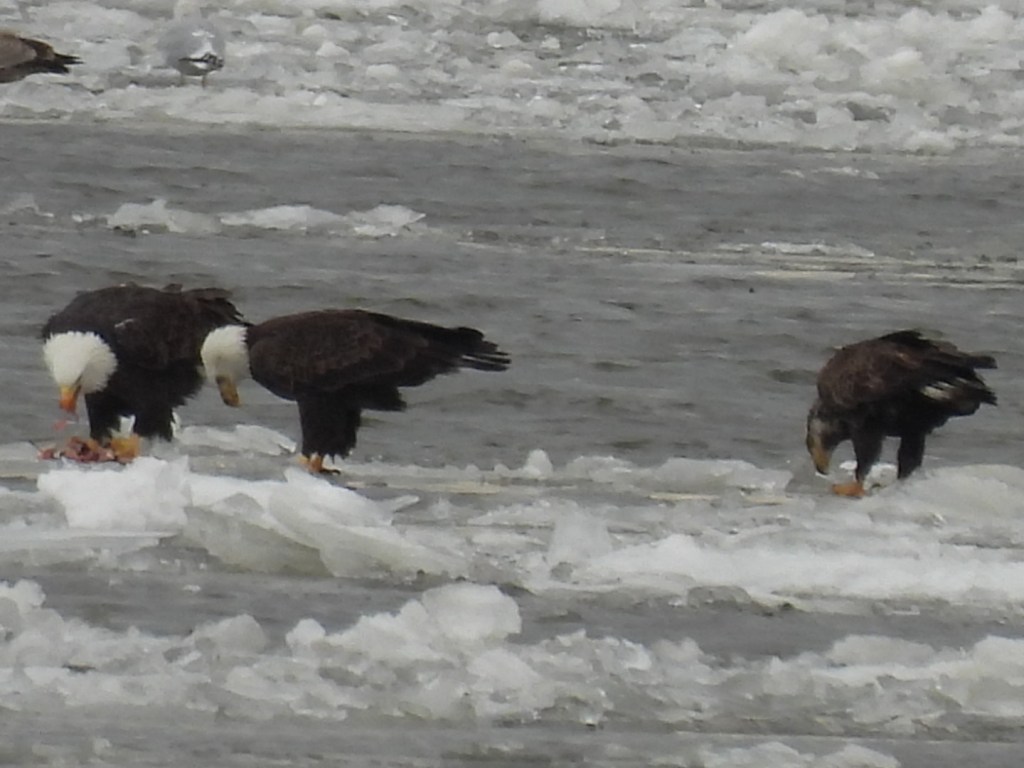
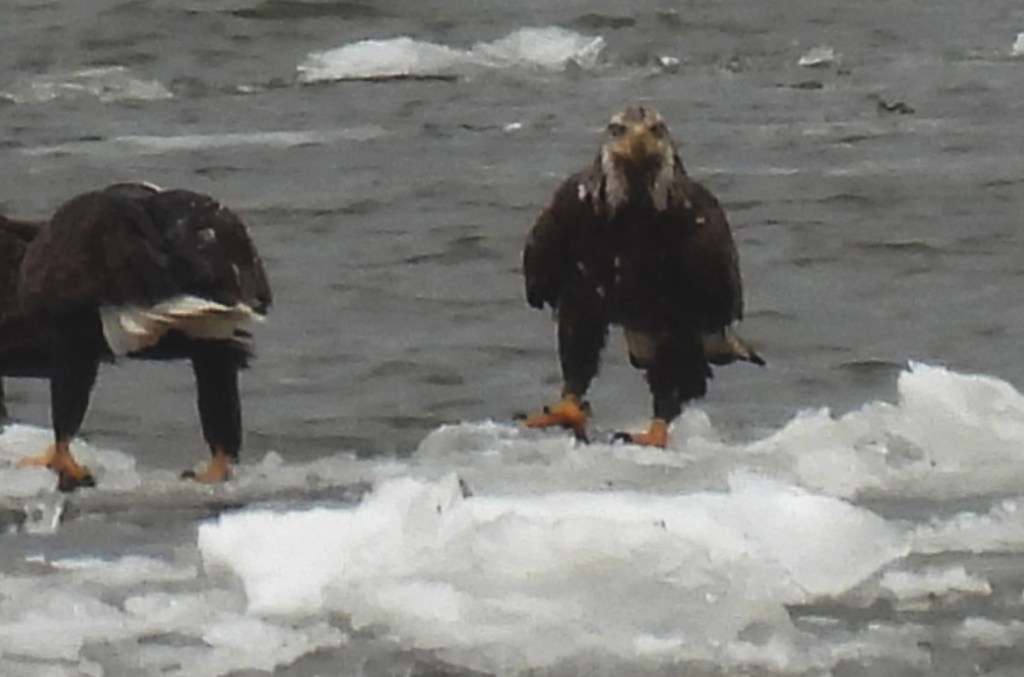
In the end, due to the distance, the snow, and the half-frozen photographer, all the photos were blurred. In one shot (below), the juvenile resembles a medieval warrior. That one was posted to Crap Bird Photography, a Facebook birding group filled with photos guaranteed to spark laughter.
On the Uber ride back to the train, my driver asked what I’d been doing. Perhaps it was unusual to be in sleepy Verplanck, NY with a camera in the middle of winter.
I told him.
With an air of She-Must-Be-Crazy amusement, he said: “You came all the way up here to take pictures of eagles?”
“Yup!”
And I laughed.
 A Parallel World